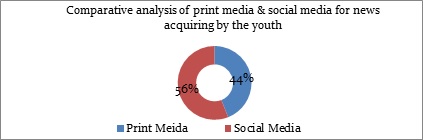
- It is most likely that the newspaper is the prior source for news consumption among youth as compared to Facebook.
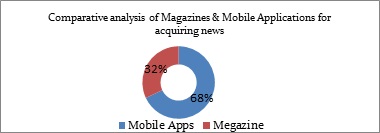
- It is most likely that mobile apps are the primary source for news consumption among youth as compared to the magazine.
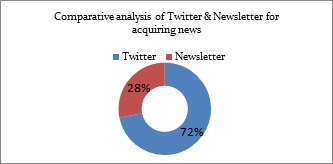
- It is most likely that the newsletters are the primary source for news consumption among youth as compared to Twitter.
- Briscoe, E., Trewhitt, E., & Hutto, C. J. (2011, October). Closing the micro-macro divide in modeling technology adoption. In Proceedings of 2nd Annual Conference of the Computational Social Science Society of America, Sante Fe, New Mexico.
- Bucy, E. P. (2003). Media credibility reconsidered: Synergy effects between on-air and online news. Journalism & Mass Communication Quarterly, 80(2), 247-264.
- Clark, S. J., Segall, M. D., Pickard, C. J., Hasnip, P. J., Probert, M. I., Refson, K., & Payne, M.C. (2005). First principles methods using CASTEP. Zeitschrift für Kristallographie, 220(5/6/2005), 567- 570
- Fidler, R. (1998). Life after 2001: redefining print media in the cyber age. Future of Print Media.
- Furlong, M. J., Chung, A., Bates, M., & Morrison, R. L. (1995). Who are the victims of school violence? a comparison of student non-victims and multi-victims. Education & Treatment of Children.
- Hall, A., & Wellman, B. (1985). Social networks and social support.
- Iyengar, R., Han, S., & Gupta, S. (2009). Do friends influence purchases in a social network (Vol. 9). Harvard Business School.
- Kwak, H., Lee, C., Park, H., & Moon, S. (2010, April). What is Twitter, a social network or a news media?. In Proceedings of the 19th international conference on World wide web (pp. 591-600). ACM.
- Lenhart, A., Purcell, K., Smith, A., & Zickuhr, K. (2010). Social Media & Mobile Internet Use among Teens and Young Adults. Millennials. Pew Internet & American Life Project.
- Leung, L. (2006). Stressful life events, motives for Internet use, and social support among digital kids. CyberPsychology & Behavior, 10(2), 204-214.
- Libai, B., Bolton, R., Bügel, M. S., De Ruyter, K., Götz, O., Risselada, H., & Stephen, A. T. (2010). Customer-to-customer interactions: broadening the scope of word of mouth research. Journal of Service Research, 13(3), 267-282.
- Ogunyemi, O. (2006). The Appeal of African Broadcast Web Sites to African Diasporas A Case Study of the United Kingdom. Journal of Black Studies, 36(3), 334-352.
- Papacharissi, Z., & de Fatima Oliveira, M. (2012). Affective news and networked publics: The rhythms of news storytelling on# Egypt. Journal of Communication, 62(2), 266-282.
- Platzer, E., & Petrovic, O. (2011). An experimental deprivation study of mobile phones, internet and TV. Computer Technology and Application, 2(8), 600- 606.
- Sala, A., Cao, L., Wilson, C., Zablit, R., Zheng, H., & Zhao, B. Y. (2010, April). Measurement-calibrated graph models for social network experiments. In Proceedings of the 19th international conference on World wide web (pp. 861- 870). ACM.
- Shaheen, M. A. (2008). Use of social networks and information seeking behavior of students during political crises in Pakistan: a case study. The international information & library review, 40(3), 142-147.
- Smith, A. (2009). The Internet's role in campaign 2008. Pew Internet & American Life Project, 15.
- Stanton, A. L. (2012). 17 (2) Fall 2012 PDF. Syrian Studies Association Bulletin, 17(2).
- Stephen , A.T., & Toubia, O. (2010). Deriving value from social commerce networks. Journal of marketing research, 47(2), 215-22
Abstract:
This study examined the priority of a young generation regarding the selection of medium for news consumption of Multan city. The rationale of the research was to explore the authority of Social Networking Medium (SNM) and explored the comparison between both genders about the consumption of media for repeated information seeking. Moreover, a survey questionnaire methodology used to explore the priorities of the youth and the sample size was five hundred in total using the purposive sampling technique. The study gave a clear hint that the use of Social Networking Medium (SNM) for news acquiring was 56 percent which is greater than the traditional media (print media), which was 44 percent. The study also pinned the point that the youth is consuming the newspaper for relevant information more than Facebook. Overall findings of the study illustrated that Social Network Medium (SNM) is the foremost source of news and information among the youth of Multan.
Key Words
Young Generation, (SNM) Social Networking Medium, Traditional Media
Introduction
Social networking is going to expand its significance around the globe now a day’s. Pakistan, which is considered a third world (underdeveloped) country, this new mode of communication (SNM) is going to establish a motivational medium of communication for youngsters. Now a day’s 3G 4G internet data is in the access of the people in the urban or developed as well as in the rural and underdeveloped areas. As far as Twitter, Face book, Yahoo, E-papers, Youtube, social media applications and other modes of social networking is concerned, these websites and applications are become a major medium for the young generation to spend their leisure time and interact with each other and in the meanwhile for getting a different type of information in terms of online news. Social Networking websites are now being used for different aspects of life, i.e. business promotion, political campaigns, advertising campaigns for different brands and products, sports activities, socialization, religious debates, dissemination of information, health awareness and analysis. Everybody has his/her own viewpoint and observations regarding any issue, event or happening (Nermeen, 2012).
The appropriation rate has been fluctuating among individuals. Man has for a long while been itching to find new and better things. Before, when printing was first distributed, it was past the human creative mind. It was an earlier source for search data. However, at the moment it is possible that while sitting in our room we can talk to the world and get social and international news in the most recent times. Paper is currently viewed as an uncommon day. Each print thing has its own particular approach, and their staff should follow it. Concerning web-based media, there is no such approach and limitations on the dispersal of information and data (Stephens, 2006).
The contribution of the media to the provision of information and the transfer of information is important. Even with the advent of electronic media, printed media has not lost its appeal or its value. The media has the potential to make a lasting impact on students' minds (World Association of Newspapers, 2010).
Web-based media apparatuses, for example, Twitter, Facebook and Yippee, can be utilized as a wellspring of data; it has become a necessity for pretty much every association to show its incentive to its clients. In the old news, the papers, organizations, government offices and different types of print media all have a similar capacity of giving data to individuals, and individuals will peruse that data. In any case, taking everything into account, they need something better. (Ruth, 2010).
Significance of the Study
Social Networking Medium (SNM) is rising as
a major source for acquiring news for youngster all around the globe because it has different variations and power to check out anything regarding their choice and desire at any time and at any place. The objective of the study to examine that either Social Network Medium (SNM) has become dominant in our country or the old mode of communication known as print media has not reduced its worth for the young generation. The purpose of the study is to investigate the new and latest dimension of mass communication, more specifically, on news consumption by the young generation in Multan, Punjab, Pakistan.
Statement of the Problem
The researcher wants to examine the priorities of the young generation regarding news acquiring and consumption by using Social Networking Media (SNM) or from Print Media. This research would explore the consumption of news by the youth of Multan; which source is dominating among the youth for the purpose of news consumption? Either print media, which is known to us as a traditional medium for news consumption, or social media, which is now day’s known as alternative media.
Objective of the Study
1. To check out the preference of the youth of Multan for selecting a medium for news consumption in social media and print media comparatively.
Literature Review
Wilson, J. (2010) contends that new media innovation like the web and interpersonal interaction are not as basic as concurrent correspondence advances, but rather as friendly innovation having a more extensive effect upon correspondence practices and social organizations.
Iyengar (2009) fights that particular receptiveness will drive media assurance. There are innumerable various segments, similar to singular interest in news and current happening around the planet. We essentially acknowledge that if our way of thinking resembles the data, we will follow it.
Papacharissi et al., (2012) clarified reports telling on Twitter about the Egyptian hashtag issue; the analyst conducted a speech test; analyze news headlines and type of news in Egypt from January 25 to February 25, 2011. They think joining news stories and feelings is straightforward, but they are declining, among other things, is rare and, in doing so, does not look really important.
Kwak et al. (2010) expounded that Twitter is an advanced mechanism of spreading the data among the majority. A large number of associations are utilizing it for changing the disposition of the majority. It will give them breaking news, features or introduced news on games, refers to or brands.
Domingo et al. (2010) researched the substance of online papers, where the clients have the opportunity to offer the remarks and thoughts on the news as they might suspect. The analyst examined 16 online papers of 2007. A subjective examination procedure was utilized. The consequences of the investigation demonstrate that crowd cooperations were found in the information on their premium.
Clark (2010) contends that the web has gotten the earlier mechanism for individuals to associate with one another. Individuals will utilize it for communication, business purposes, work chasing and with respect to managers are a concern, they will utilize interpersonal interaction sites for foundation data of occupation candidates. The scientist examined that a couple of bosses have arrangements to enlist the candidate on the basis of data which is given on these long range interpersonal communication sites. All in all, the specialist direct the candidates on how to utilize such sites.
Furlong et al. (2012) examined that the advances, for example, web and person to person communication at home, to investigate more. At home, they feel simple to learn more with their own character. Here the data can be formal, casual, semi-formal or coincidental. The youthful clients will utilize it in a simple and extensive way. Nobody discloses to them how to utilize such sites; they will utilize it with their own style.
Leung (2010) looks at the entomb linkage among web connectedness, data education, and personal satisfaction. Review strategy is utilized; with phone overview, 756 web clients are met. The scientist closed it that there is a critical connection between web connectedness and data education. Also, there is a solid connection between data proficiency and personal satisfaction.
Research Question
RQ.1: What is the prior source of news for the youth of Multan, either print media (Traditional Media) or social networking medium (SNM)?
Hypothesis
Theoretical Framework
The current study is theoretically linked with media dependency theory which demonstrates its application to the online medium and also to study different variations of it. Furthermore, it highlights how young masses are depending on online media for in-depth news information and how they operate this medium as compared to old media for the purpose of getting information (Daniel, 2008).
This study would investigate the priority of the youth regarding the selection of media for the purpose of news and information. In the meanwhile, this study would explore why young users are going to priorities one medium of information from another medium of news and information? Now a day’s most young adults are dependent on different sort of media for news and information gathering. With the help of media dependency theory, the researchers would explore the current phenomenon efficiently.
Methodology of Study
According to the need of the study and the researcher utilize the “survey methodology” for the purpose of data collection.
Questionnaire Construction
For the purpose of data collection, a survey questionnaire has been designing by the researcher. Meanwhile, constructing of research questionnaire, the researcher focused on the research objectives, research questions and the hypothesis of the study. Furthermore, the researcher carefully examines the previously available literature to shape the research questionnaire appropriately.
The procedure of Sampling and its Size:
The research has been conducted in the city of Multan, located in the south of the province Punjab, Pakistan. The sample size for this research contained five hundred research respondents to obtain dependable and reliable findings. The researcher utilizes
the purposive sampling technique to obtain the targeted sample. For this purpose, the researcher found the young respondents who have access to 3G or 4G internet connections. The researcher finds out the required sample for the research project from different colleges and universities which are located in the city of Multan. Moreover, for the purpose of choosing colleges and universities, purposive sampling has been utilized by the researcher. Both genders have been chosen for data collection from different colleges and universities. The researcher wanted to find out the priority of the young generation regarding the selection of medium. For this purpose, the researcher gave equal representation to the males and females. Finally, a sample of 250 males and 250 females are chosen by the researcher to carry out the study project.
Areas for Data Collection
After utilizing the purposive sampling technique, the researcher has collected data from different educational institutes of Multan. The data was gathered through a semi constructed research questionnaire. The list of the educational institutes from where data has been collected is given below
Areas for Data Collection
| Institutes Names width="146" valign="top">Female Respondents width="126" valign="top">Male Respondents width="137" valign="top">Total Respondent’s | > Bahauddin Zakariya University, Multan width="146" valign="top">38(38%) width="126" valign="top">62(62%) width="137" valign="top">100 | > Multan Post Graduate College width="146" valign="top">14(24%) width="126" valign="top">44(76%) width="137" valign="top">58 | > Global College for Commerce width="146" valign="top">20(29%) width="126" valign="top">49(71%) width="137" valign="top">69 | > Memona Post Graduate College width="146" valign="top">80(100%) width="126" valign="top">00(0.00%) width="137" valign="top">80 | > Government Home Economics College width="146" valign="top">98(100%) width="126" valign="top">00(0.00%) width="137" valign="top">98 | > Government Emerson College width="146" valign="top">00(0.00%) width="126" valign="top">95(100%) width="137" valign="top">95 | > Total width="146" valign="top">250(50%) width="126" valign="top">250(50%) width="137" valign="top">500(100%) |
Population of the Study
Young people who are studying in any educational institutes and have access to the 3G or 4G internet connections were considered the population of the current study.
Data Interpretation & Analysis
For the purpose of data analysis and interpretation, the researcher utilizes SPSS Software.
Findings of the Study
Table 1: The Major Source of News Consumption for Youth is Newspaper
| Gender width="16%" valign="top">SA width="16%" valign="top">AG width="13%" valign="top">N width="11%" valign="top">DA width="11%" valign="top">SD width="12%" valign="top">Total | > Male width="16%">104(42%) width="16%">64(26%) width="13%">17(7%) width="11%">44(17%) width="11%">21(8%) width="12%">250(100%) | > Female width="16%">42(17%) width="16%">18(7%) width="13%">148(59%) width="11%">34(14%) width="11%">8(3%) width="12%">250(100%) |
| Gender width="14%" valign="top">SA width="13%" valign="top">AG width="13%" valign="top">N width="13%" valign="top">DA width="14%" valign="top">SD width="16%" valign="top">Total | > Male width="14%">10(4%) width="13%">19(8%) width="13%">51(20%) width="13%">82(33%) width="14%">88(35%) width="16%">250(100%) | > Female width="14%">38(15%) width="13%">64(26%) width="13%">20(8%) width="13%">26(10%) width="14%">102(41%) width="16%">250(100%) |
| Gender width="13%" valign="top">SA width="14%" valign="top">AG width="14%" valign="top">N width="17%" valign="top">DA width="17%" valign="top">SD width="9%" valign="top">Total | > Male width="13%">7(3%) width="14%">11(4%) width="14%">19(8%) width="17%">111(44%) width="17%">102(41%) width="9%">250 | > Female width="13%">6(2%) width="14%">19(8%) width="14%">12(5%) width="17%">130(52%) width="17%">83(33%) width="9%">250 |
| Gender width="13%" valign="top">SA width="14%" valign="top">AG width="13%" valign="top">N width="13%" valign="top">DA width="16%" valign="top">SD width="13%" valign="top">Total | > Male width="13%">20(8%) width="14%">28(11%) width="13%">10(4%) width="13%">64(26%) width="16%">128(51%) width="13%">250(100%) | > Female width="13%">48(19%) width="14%">76(30%) width="13%">14(6%) width="13%">25(10%) width="16%">87(35%) width="13%">250(100%) |
| Gender width="15%" valign="top">SA width="15%" valign="top">AG width="11%" valign="top">N width="16%" valign="top">DA width="15%" valign="top">SD width="13%" valign="top">Total | > Male width="15%">24(10%) width="15%">28(11%) width="11%">8(3%) width="16%">143(57%) width="15%">47(19%) width="13%">250(100%) | > Female width="15%">63(25%) width="15%">52(21%) width="11%">12(4%) width="16%">34(14%) width="15%">89(36%) width="13%">250(100%) |
| Gender width="14%" valign="top">SA width="14%" valign="top">AG width="13%" valign="top">N width="16%" valign="top">DA width="14%" valign="top">SD width="13%" valign="top">Total | > Male width="14%">62(25%) width="14%">28(11%) width="13%">14(6%) width="16%">97(38%) width="14%">49(20%) width="13%">250(100%) | > Female width="14%">96(38%) width="14%">33(13%) width="13%">11(4%) width="16%">31(12%) width="14%">79(33%) width="13%">250(100%) |